
Whole-System
Healing
Shoshannah works holistically with mind, body, nervous system, and relationships - addressing root causes, not just symptoms.

Expertise in Complex
& Chronic Patterns
Specialises in anxiety, trauma, chronic health issues, nervous system sensitivity, and family/relationship dynamics - especially when standard methods haven’t worked.

Integrated,
Lasting Change
Combines therapy, mindscaping, genetics, and natural medicine to create lasting transformation, focusing on prevention, resilience, and deep understanding - not quick fixes.
Shoshannah works on-line nationally and internationally,
and in person in St Albans, Hertfordshire, UK

Shoshannah Phoenix On Dyslexia, Nature, and the Language of Detail
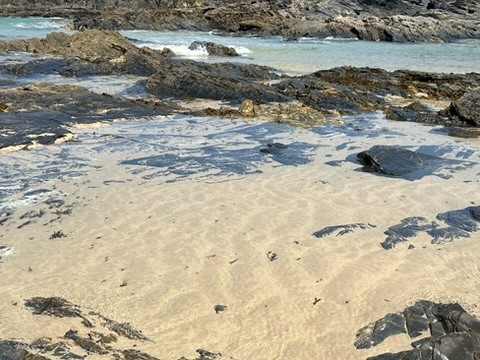
There are certain places where the mind becomes absorbed in a particular kind of attention, and for me one of those places is the rocky shoreline at Trevone in Cornwall. It is not simply the beauty of the sea or the openness of the coastline that draws me there, although those elements are certainly present. What captivates me most is the extraordinary detail that reveals itself when I slow down and look closely at the landscape beneath my feet.
The rocks are textured and layered from centuries of tides moving in and out. Small molluscs cling to the stone, barnacles cluster together in intricate formations, seaweed wraps itself around edges and crevices, and rock pools quietly hold miniature ecosystems that exist only because the sea has temporarily withdrawn. Walking along that beach becomes less about travelling from one point to another and more about noticing the remarkable complexity that exists in the smallest details of the natural world.
Over time I have taken hundreds of photographs in places like this, not because I set out to document the coastline in any formal way but because certain patterns and textures capture my attention in a way that feels almost instinctive. A shell spiral embedded in rock, the branching structure of seaweed, the subtle colour gradients in algae spreading across stone, or the first new shoots of a plant pushing through a crack in the cliff path all seem to carry a quiet significance. These are not dramatic landscapes in the conventional photographic sense. They are fragments, details, moments of pattern and form that reveal something about how nature organises itself. When I look back through the images later, what becomes striking is how consistently my attention has been drawn toward these intricate structures rather than toward sweeping panoramic views.
Only gradually did it begin to occur to me that this way of observing the world may be closely connected to dyslexia. Dyslexia is most commonly discussed in relation to reading and writing difficulties, and those challenges are very real for many people. Yet dyslexia also reflects differences in how the brain processes information more broadly. Many dyslexic thinkers rely heavily on visual and spatial processing rather than strictly linear language systems. Instead of organising the world primarily through words and sequences, the dyslexic mind often moves through images, patterns, structures and relationships between things. This kind of cognition tends to notice connections that may remain invisible to more sequential styles of thinking.
When someone with this kind of pattern-oriented perception walks along a rocky coastline, the environment becomes full of information. The eye begins to detect repeating structures and subtle variations that might otherwise pass unnoticed. The spiral of a mollusc shell echoes the spiral of fossils embedded in the surrounding rock. The branching form of seaweed mirrors the branching structures seen in plants higher up the cliff face. Tiny clusters of barnacles arrange themselves in dense geometric formations that resemble patterns found in completely different ecosystems. The natural world reveals itself not simply as scenery but as a living network of repeating shapes and structures that exist across many different scales.
This attention to pattern and detail is rarely recognised within traditional educational environments. Schools tend to prioritise speed of reading, accuracy of spelling, and the ability to process written information in orderly sequences. A child whose attention naturally drifts toward visual patterns in nature, the structure of plants, the shapes of shells or the textures of stone is not usually asked to develop that observation further. Instead, their strengths may remain hidden behind the difficulties they experience with conventional literacy tasks. Yet outside the classroom, the ability to perceive structure and pattern can become a powerful way of understanding the world.
Scientists, artists, designers, engineers and naturalists have all relied on precisely this kind of observation. The recognition of patterns often begins with quiet attention to detail, noticing relationships between forms that at first appear unrelated. Nature is full of these repeating structures. Spirals appear in shells, plants, weather systems and galaxies. Branching structures appear in trees, rivers, lungs and neural networks. Layered formations appear in rock strata, coastlines and cloud systems. When someone becomes fascinated by these details, they are often engaging with the underlying architecture of the natural world.
For me, places like Trevone have become environments where that way of seeing the world becomes particularly alive. The photographs I collect there feel almost like visual field notes, small records of encounters with the patterns and textures that quietly shape the landscape. Each image captures a fragment of something much larger, yet within those fragments there is extraordinary complexity. The spiral of a shell, the subtle symmetry of barnacles, the delicate branching of seaweed and the slow emergence of new plant growth all reveal how intricately organised the natural world truly is.
Perhaps it is not surprising that a dyslexic mind would feel drawn toward environments like this. The language of the landscape is not written in sentences or paragraphs. It is written in form, texture, pattern and movement. For a mind that naturally processes the world visually and spatially, these environments provide endless material for curiosity and reflection. Standing on a rocky shoreline and examining the details beneath one's feet can become an exploration of structure, rhythm and design that extends far beyond the immediate moment.
Over time I have come to realise that what began simply as a personal fascination with photographing shells, plants, rocks and small natural details is also a reflection of how my mind works. Dyslexia may complicate the process of reading and writing, but it also shapes perception in ways that allow patterns and structures to become visible in unexpected places. The natural world offers an endless field in which those patterns can be observed, studied and quietly appreciated.
Walking along the rocks at Trevone, camera in hand, often feels less like documenting a landscape and more like engaging in a form of visual thinking. Each small detail becomes part of a much larger story about pattern, growth, and the intricate ways nature organises itself. In that sense, the beach becomes not only a place of beauty but also a place of observation, reflection and understanding, where the language of detail speaks more clearly than words ever could.